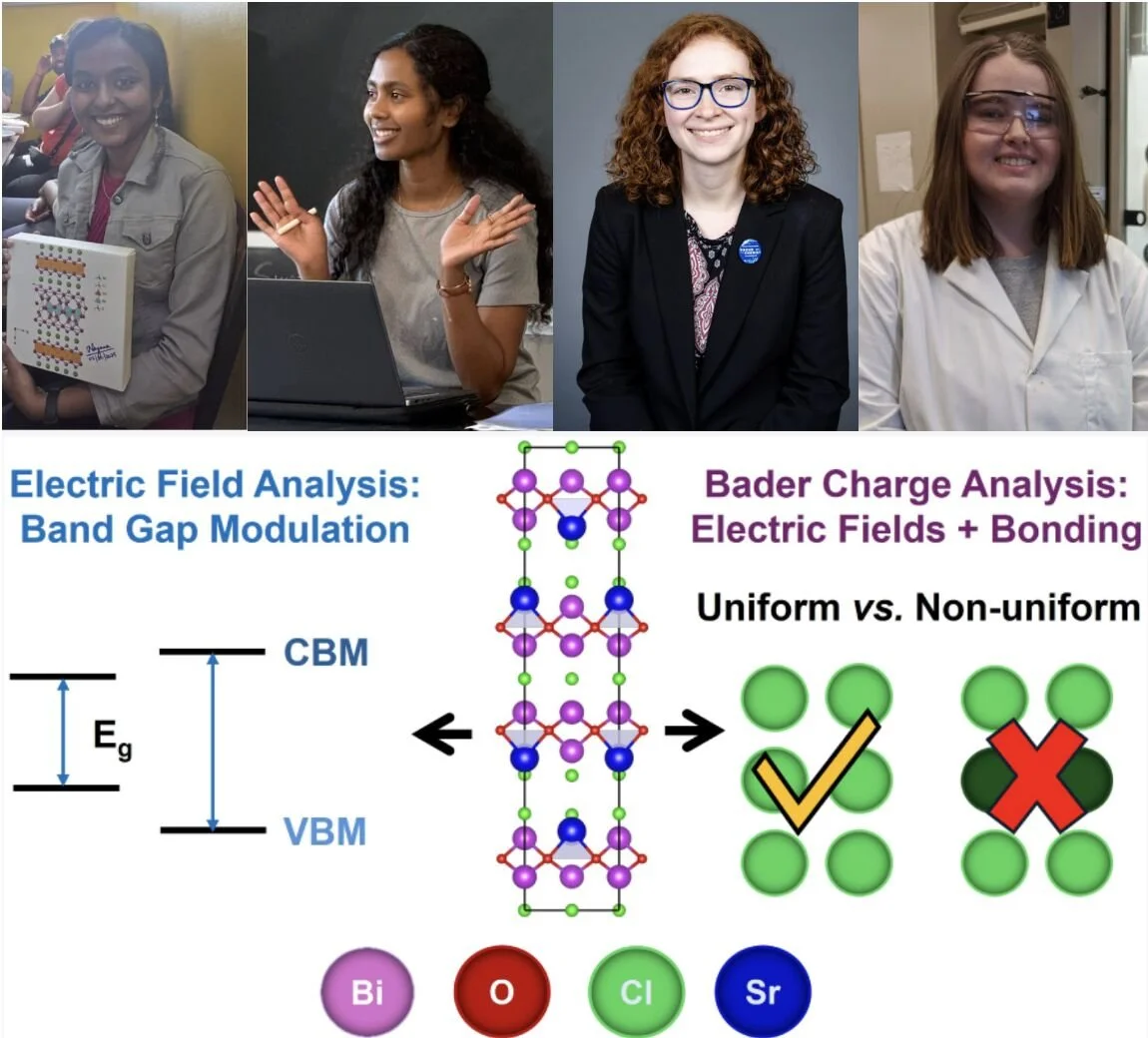
🎉 Congratulations 🎉 to Nayana Christudas Beena, Varsha Kumari (equal-contribution first authors), Emily Ward, and Megan Knobeloch for their wonderful work, now published in the Journal of the American Chemical Society (JACS) ( https://pubs.acs.org/jacsat/article/doi/10.1021/jacs.6c15661/5451203/Chemical-Bonding-Rules-for-Stacking-Sequence )! 🎉.
The question Nayana (who synthesized the materials) and Megan (who performed electron microscopy) brought to Varsha and Emily was: Why are some stacking sequences of charged layers stable in solids and superlattices, but not others?
This is an old question, with surprising consequences, including the superconducting SrTiO3/LaAlO3 interface [2]. Traditionally, much of the explanation has focused on minimizing the electric fields produced by charged layers.
But our materials can even contain two neighboring, negatively charged Cl layers; how can they be stable?
Our answer, inspired by Pauling's Fifth Rule, is to consider chemical bonding and minimize the variation in effective charges between atoms in the same species (quantified using Bader charge). Varsha found that Cl in a bilayer tends to become less negatively charged than those in a monolayer due to covalent bonding (think Cl2 molecules in which ions are neutral while in NaCl, the Cl is 1-). Electric fields, instead of being minimized, may be *needed* to make the Cl ions equivalent. Bi 3+ for example, may lead to more covalent bonding than Sr 2+, further complicating the simple electric fields picture.
Electric fields of course still determine the electronic structure: smaller internal fields generally favor larger band gaps, while stronger fields reduce them, as also explored by Ogawa and Walsh [3]. But the most stable structure need not have the smallest field or largest band gap! In our materials, the preferred structure has an intermediate gap.
The electronic structure is also influenced by Bi lone-pair bonding, building on Emily's earlier work on visualizing lone pairs in solids [4].
This is our first joint publication from the NSF-funded collaboration between Sara Skrabalak's group and ours.
Wonderful to see synthesis, electron microscopy, and theory come together to answer a fundamental question about chemical bonding!
References:
[1] Our JACS paper: https://pubs.acs.org/jacsat/article/doi/10.1021/jacs.6c15661/5451203/Chemical-Bonding-Rules-for-Stacking-Sequence
[2] Nakagawa, Hwang & Muller, Nature Materials: https://www.nature.com/articles/nmat1569
[3] Ogawa & Walsh, JACS: https://pubs.acs.org/jacsat/article/147/1/821/3735625/Electrostatic-Control-of-Electronic-Structure-in
[4] Emily's work on lone pairs in solids: https://iopscience.iop.org/article/10.1088/2515-7639/adc33e