
I’ve made this introductory video for people who are interested in correlated electron materials and are either new to the field or may want to learn something new. I cover things ranging from Jahn-Teller and trigonal distortions, Peierls distortion, band renormalization in correlated metals and the importance of beyond-Density Functional Theory methods, spin frustration, and so on. This is the result of A LOT of work, and I’ve found both new students, and some experienced scientists who might not be familiar to one aspect or another of the phenomenology presented here have found it interesting. So, please enjoy: https://www.youtube.com/watch?v=sp_f8UlVJOE
Trigonal Symmetry and its Electronic Effects in 2D Halides and Other Materials
This paper is now published in PRB.
One of the difficulties I’ve found in the literature when looking at transition metal halides and dihalides, was to understand what mechanism makes these materials insulating: it’s pretty hard to understand why a 3-fold degenerate t2g orbital basis would lead to an insulating material, for an orbital filling of 1, 2, 4, 5. This is the model many people work with, however, and the result are often fancy explanations for pretty simple behavior.
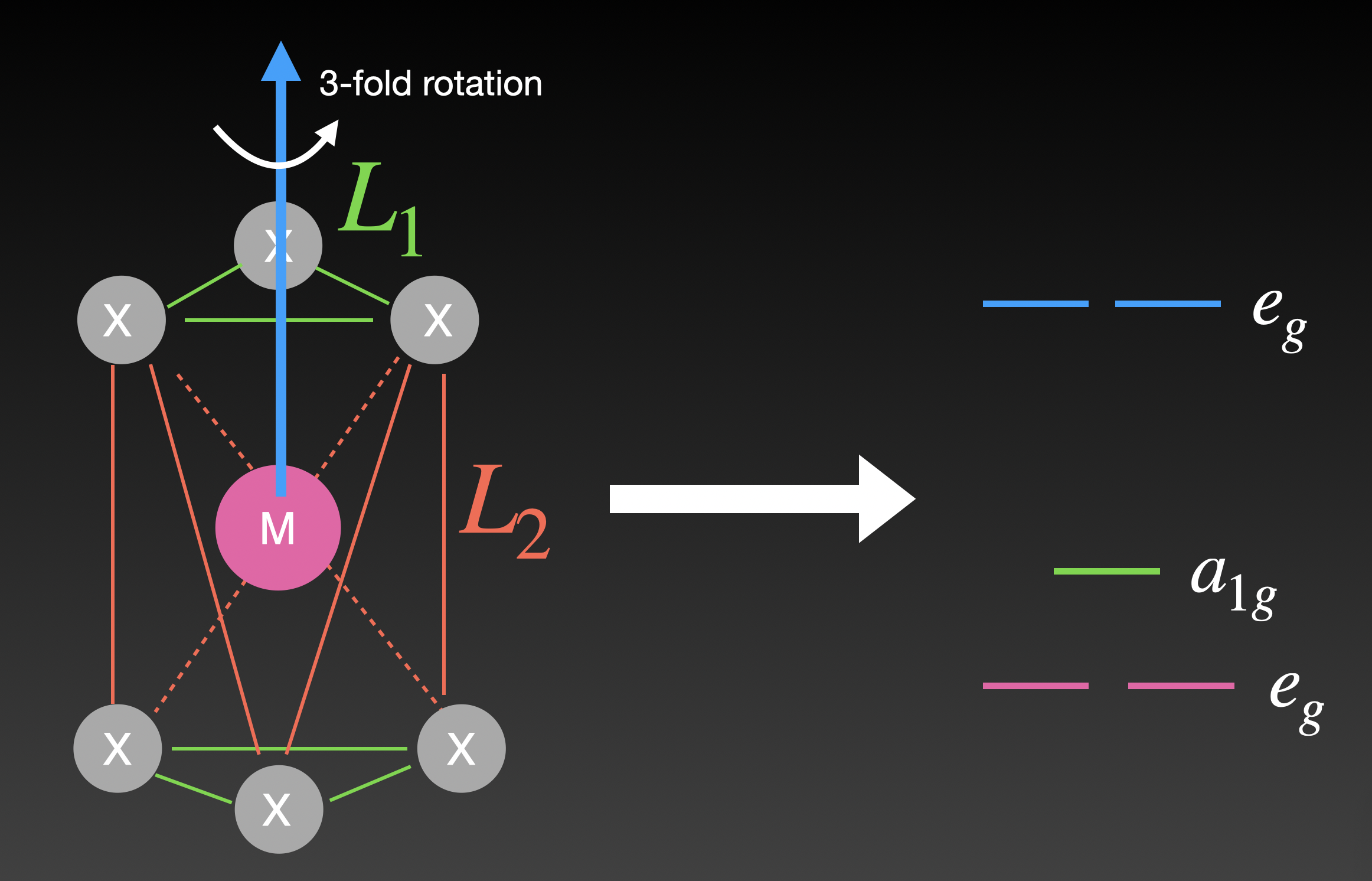
The explanation is quite simple: the basis is not degenerate to begin with - and due to the broken symmetry inherent in a 2D material, it can’t be. I explain here how to reliably build a basis that conforms to the appropriate trigonal symmetry, and provide some simple matlab scripts to do so. This has important implications: particularly in the potential spin-liquid material RuCl3, which many people model as having a 3-fold degenerate orbital basis as the basis for their models. This class of materials - and more generally, edge and face-connected octahedra - have their crystal field splittings parametrized by ligand-ligand bond-length distances rather than metal-ligand bond length differences. I explain this in this 10 min talk, as well as in a paper with James Rondinelli and Andy Millis.